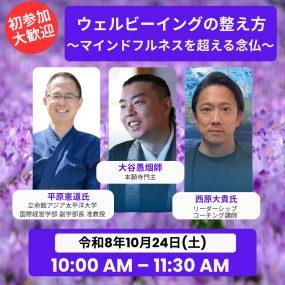
B2B Seminar Vol.35: “How to Cultivate Well-Being: Nembutsu Beyond Mindfulness”|「ウェルビーイングの整え方~マインドフルネスを超える念仏~」

In this roundtable discussion, the participants engaged in a dialogue on well-being, mindfulness, and the contemporary application of Buddhist thought. Mr. Nishihara provided an overview of his book, The Habit of Not Trying Too Hard, explaining how defensive instincts and attachment give rise to suffering, and sharing the importance of “Tariki innovation” He also reported
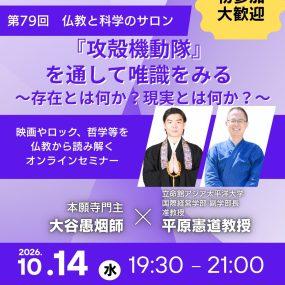

仏教と科学のサロンNo.79: “Exploring Yogacara Through ‘Ghost in the Shell’ What Is Existence? What Is Reality?”|『攻殻機動隊』を通して唯識をみる~存在とは何か?現実とは何か?~

At this salon, His Eminence Otani Guen, Head of the Otani School, and Professor Hirahara engaged in a dialogue on the anime Ghost in the Shell and the Buddhist philosophy of “Yogācāra.” As an overview of Yogācāra, the Head of the Otani Sect explained the concept of “emptiness” (śūnyatā)—the idea that all existence is constituted

仏教と科学のサロン Vol. 78: “Does AI Have a Heart or a Soul? — Ghost in the Shell —”|「AIに心・魂はあるのか?〜攻殻機動隊〜」

During the seminar, the two speakers discussed the background of *Ghost in the Shell* and the question of whether AI possesses a mind or soul, confirming that the 1995 animated film was a significant work created during the emergence of the AI and the Internet became widely known. Professor Hirahara pointed out that, unlike previous

Screw the “genetic mess”!|糞くらえ「遺伝子ガチャ」!

https://www.technologynetworks.com/genomics/news/healthy-lifestyle-can-overcome-poor-genes-by-60-386316 It’s really important, daily physical activity and exercise. That is the result of a large study that found that environmental factors may reverse the effect of genetic risks for a longer or shorter life span. “The researchers maintain that their results indicate that genetic risks for a shorter lifespan may be offset by a

【education】Bioethics in healthcare research|医学研究における生命倫理

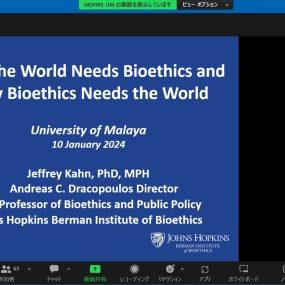
Recently, I have been touching on bioethics, or rather ethics in medical/healthcare research. Yesterday, I participated in a lunch talk, “Why the World Needs Bioethics and Why Bioethics Needs the World,” hosted by the Master of Health Research Ethics (MOHRE) at the University of Malaya (UM) Faculty of Medicine. The lecturer was Prof. Dr. Jeffrey

【education】Project to develop a telehealth curriculum at a UM Faculty of Medicine|マラヤ大医学部でのtelehealthカリキュラム策定プロジェクト

We, the eHealth Unit of the Faculty of Medicine at the University of Malaya, are currently working with a team from the Medical Education and Research Development Unit, whom we often work together with, to develop a medical education curriculum on “teleheath”. Telehealth (or telemedicine as its subset) is a thing that continues to be

wasabi can boost memory function?|ワサビで記憶力増強?

https://www.cbsnews.com/news/wasabi-memory-boost-japanese-study-finds/ This is a pretty good story! It’s a report on an experiment at Tohoku University showing that Wasabi, a Japanese spice that is the pride of Japan (it’s on sushi all the time!), boosts memory in the elderly. It seems that a rare substance called 6-MSITC contained in Wasabi is responsible for this effect.

【education】APRU Global Health Ethics 2023 course completed|APRUグローバルヘルス倫理2023コースの修了参加証明書が届く

APRU (Association of Pacific Rim Universities) is a large education and research network with about 60 member universities around the world, and it is working to improve the quality of its researchers by offering free graduate-level classes among its member universities. Universiti Malaya, to which I belong, is also a member institution, and I was

【ytube】”How Did You Get Into Buddhism?” on Youtuber Rev. Sakuranbo’s channel|「Youはどうして仏教に?」僧侶Youtuber桜嵐坊師のチャンネルに出演

I once appeared on the Youtube channel of Rev. Sakuranbo, with three of my colleagues from my online salon. One of us is his old, old friend. It was surprisingly well received, and I was grateful for the invitation to appear on his channel as solo this time. For a full hour, I talked about