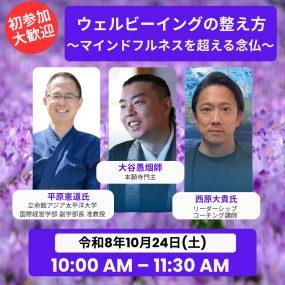
B2B Seminar Vol.35: “How to Cultivate Well-Being: Nembutsu Beyond Mindfulness”|「ウェルビーイングの整え方~マインドフルネスを超える念仏~」

In this roundtable discussion, the participants engaged in a dialogue on well-being, mindfulness, and the contemporary application of Buddhist thought. Mr. Nishihara provided an overview of his book, The Habit of Not Trying Too Hard, explaining how defensive instincts and attachment give rise to suffering, and sharing the importance of “Tariki innovation” He also reported
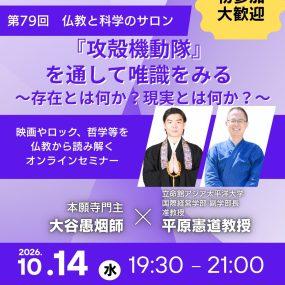
仏教と科学のサロンNo.79: “Exploring Yogacara Through ‘Ghost in the Shell’ What Is Existence? What Is Reality?”|『攻殻機動隊』を通して唯識をみる~存在とは何か?現実とは何か?~

At this salon, His Eminence Otani Guen, Head of the Otani School, and Professor Hirahara engaged in a dialogue on the anime Ghost in the Shell and the Buddhist philosophy of “Yogācāra.” As an overview of Yogācāra, the Head of the Otani Sect explained the concept of “emptiness” (śūnyatā)—the idea that all existence is constituted

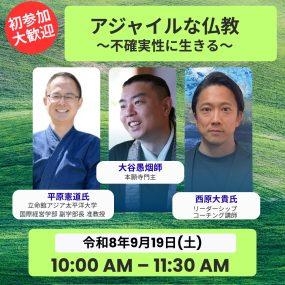
B2B Seminar Vol.34: “Agile Buddhism: Living with Uncertainty”|「アジャイルな仏教 ~不確実性に生きる~」

As part of his recent updates, Mr. Nishihara reported on his interactions with Sri Lankan Buddhist monks in a Vietnamese temple in Texas, and on business practices that incorporate Buddhist principles, as discussed with the head of supply chain at a major semiconductor company in Kyoto. Professor Hirahara pointed out, from the perspective of “Agile

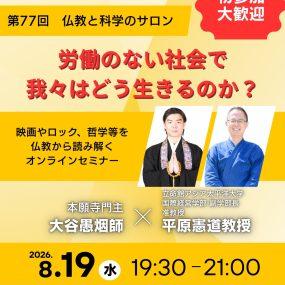
仏教と科学のサロン Vol. 77: “How will we live in a society without work?”|「労働のない社会で我々はどう生きるのか?」

The main topic of the discussion centered on the findings of social science research to date regarding “basic income/BI,” including reports that a two-year experiment in Finland resulted in an increase in the employment rate and a decrease in the number of people leaving their jobs. Professor Hirahara noted that, within the research communities of

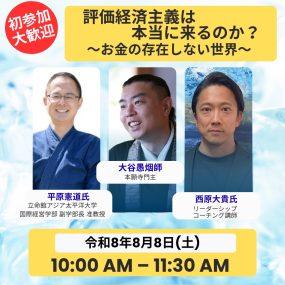
B2B Seminar Vol.33: “Is the “Reputation Economy” Really Coming? –A World Without Money–“|「評価経済主義は本当に来るのか?~お金の存在しない世界~」

This seminar centered on the themes of “reputation economics” and “a world without money,” with discussions focused on the “evaluation economy” as explained by Toshio Okada and Elon Musk’s vision for the future. The panelists examined the possibility of a transition from a monetary economy to a credit-based economy, and ultimately to an economy based

B2B Seminar Vol.32: “Passion and Business: “What’s wrong with making money?””|「パッションとビジネス 『お金儲けして、 何が悪いんですか?』」

The main purpose of this salon, held under the theme “Passion and Business: What’s Wrong with Making Money?,” was to discuss the relationship between business and money from a Buddhist perspective. At the beginning of the seminar, Mr. Nishihara discussed the meaning of profit in the context of passion and business, as well as giving

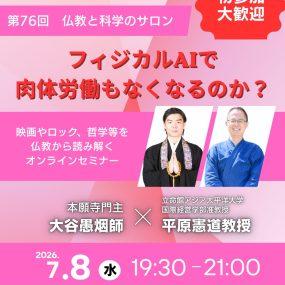
仏教と科学のサロン Vol. 76: “Will Physical AI Put an End to Manual Labor?”|「フィジカルAIで肉体労働もなくなるのか?」

A discussion on the future of physical AI and manual labor was held between His Eminence Otani Guwen, Head of the Hongwanji Sect, and Professor Hirahara. Professor Hirahara described physical AI as “the fusion of robotics and AI” and discussed the background behind the development of robotics such as Aibo and Asimo in perspective. During

B2B Seminar vol.31: “The Art of Management: How to Develop a Vision”|「経営のアート~ビジョンの描き方~」

In the main session of the seminar, Professor Hirahara spoke on the topic of how to develop an “artistic vision” for business, while Monk Nishihara explained the importance of having a vision and the need to break away from the status quo to aim for tenfold growth. Professor Hirahara touched on the relationship between art

仏教と科学のサロン Vol. 75: “The Rift Between the Baby Boomer Generation and Baby Boomer Jr. — The Death of God and the Changing Nature of the Curse”|「団塊の世代と団塊Jr.の断絶~神の死と変質する呪い~」

The lecturers discussed the ideological divide between generations, focusing in particular on the differences in values between the postwar generation (the baby boomers) and their children (Generation X). The conversation ranged from the secularization of mythology and Nietzsche’s idea that “God is dead” to contemporary anime and superhero culture, and the group discussed how works

B2B Seminar Vol.30 “We don’t need motivation”|「モチベーションなんていらない」

This conference was held under the theme “We Don’t Need Motivation.” Participants included His Eminence Otani, the Head of the Shingon Sect; Professor Hirahara; and Reverend Nishihara. Reverend Nishihara argued that the concept of motivation is, in fact, unnecessary, citing Aesop’s fable of the three bricklayers as an example to explain how differences in sense