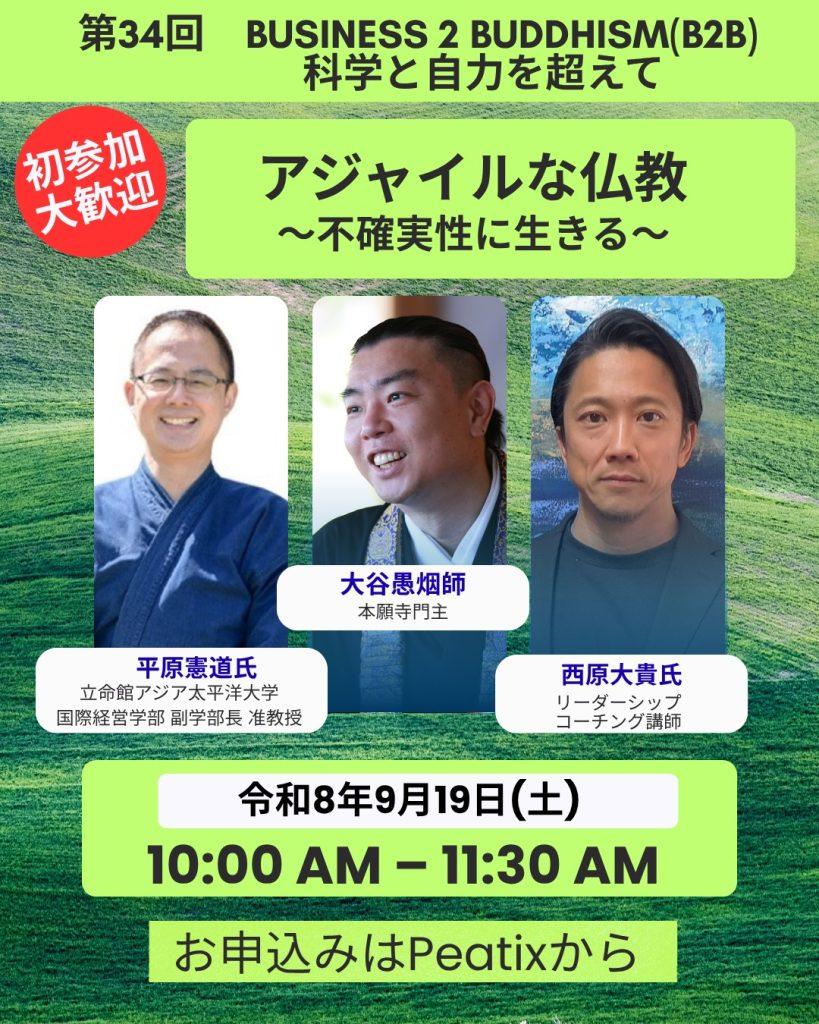
As part of his recent updates, Mr. Nishihara reported on his interactions with Sri Lankan Buddhist monks in a Vietnamese temple in Texas, and on business practices that incorporate Buddhist principles, as discussed with the head of supply chain at a major semiconductor company in Kyoto. Professor Hirahara pointed out, from the perspective of “Agile Buddhism,” that we must be careful not to lose sight of Buddhist principles and discussed the risks of clinging to overly rigid, waterfall-style structures of religions. The salon also featured a discussion on the extent to which Japanese Buddhism had operated in an agile manner in the past and how that agility was lost. Rev. Guen pointed out the possibility that Theravada Buddhism in Sri Lanka—which is often mistakenly viewed as a rigid, waterfall-style system by Mahayana Buddhists—may actually be far more agile today, and the relationship between this trend and geopolitical developments was also discussed.
西原氏は最近のアップデートとして、テキサスのベトナム寺院でのスリランカ仏教僧との交流や、京都の大手半導体企業のサプライチェーン責任者との仏教的思考を活かしたビジネス実践について報告した。平原教授はアジャイルな仏教の観点から、仏教の原理原則を失わないよう注意すべきだと指摘し、ウォーターフォール型の、堅牢すぎる構造に執着することのリスクについて議論した。サロンでは、日本の仏教が過去にどの程度アジャイルに動いていたか、それがどのように失われたのかについても話し合われた。愚烟門主は、(大乗仏教がウォーターフォール型の硬直したシステムだと勘違いしがちな)スリランカの上座部仏教が、現在は遥かにアジャイルである可能性を指摘し、その傾向と地政学的な動向との関係性についても議論された。